AI Engineer World's Fair 2026: Days 3 and 4
Somebody in AIWF scheduling has a sense of humor, intentional or not. Thariq Shihipar opened Day 3 at 9:05, followed twenty minutes later by Tariq Shaukat, who actually acknowledged the coincidence on stage himself. Two Tariqs, back to back, and I couldn't tell you if that was deliberate booking or just how this industry works now. Fun way to kick off the day, but it's not what actually stuck with me.
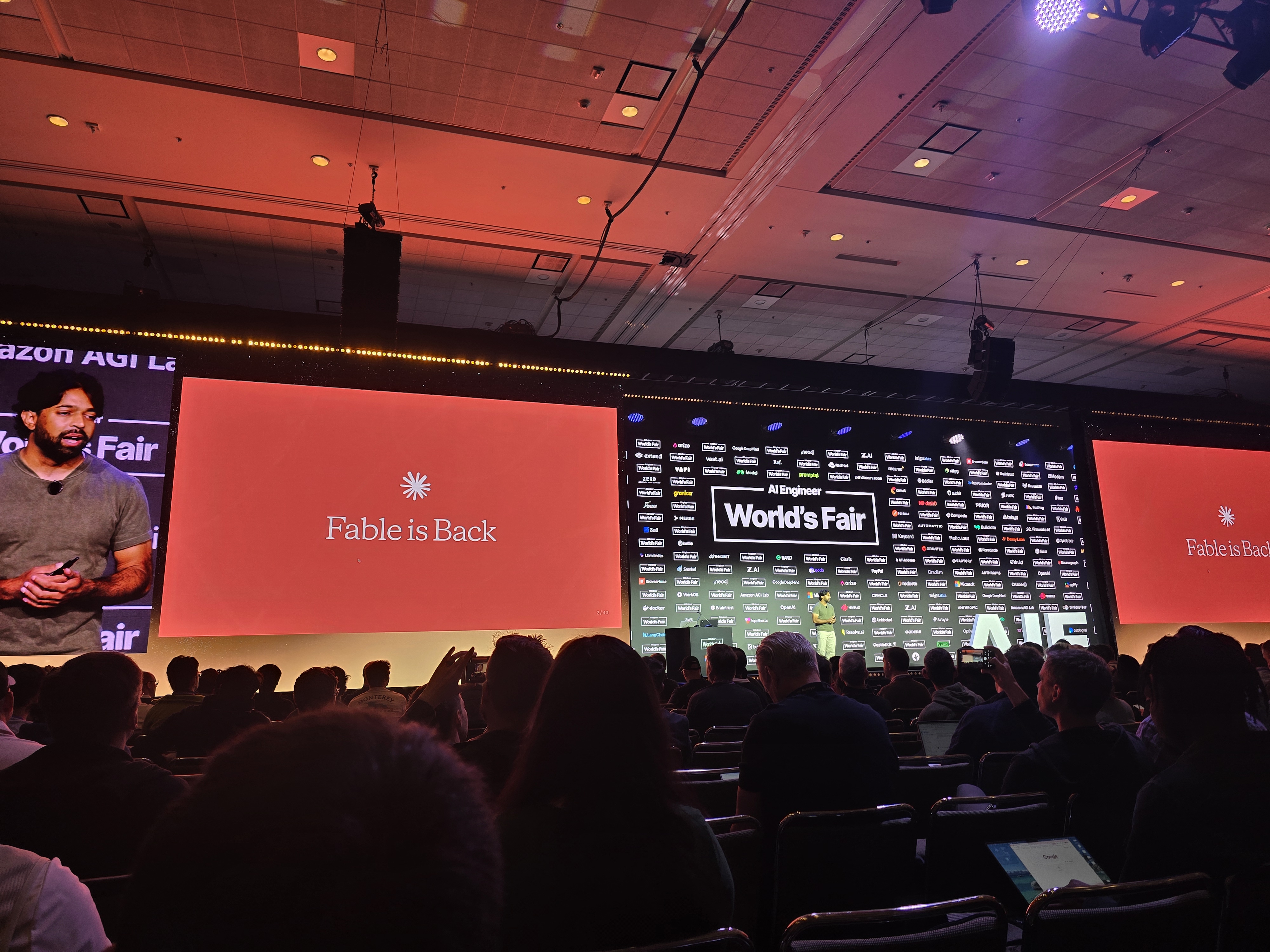
My coworkers and I had already noticed Anthropic was conspicuously missing from the conference back on Day 2, no logo on the sponsor board, no logo on the main stage backdrop, nothing. Then Day 3 morning, Shihipar walks out to give the opening keynote for Fable, and there's Anthropic's logo, right there on the main stage backdrop behind him, with all the other sponsor logos. It hadn't been there Day 1, it hadn't been there Day 2, just showed up the same morning their product launched.
Product's the wrong word, actually, Anthropic never calls it that. It's always a model, something for us to use, never something they're selling. Pair that framing with "Being Unreasonable," one quadrant of Shihipar's own four-part talk twenty minutes earlier, literally: ask the model, not the product, to do unreasonable things, and you get a genuinely slick piece of marketing. It's unreasonable to even call it a product. That's what sent me looking. By the afternoon I'd photographed the actual sponsor board and confirmed it: no Anthropic, anywhere on it. Hype on the screen behind the speaker, absence on the wall that actually costs money to get your name on.
Let's go over the Day 3 and 4 timelines.
Three keynotes, three pointers, no re-explaining:
9:05 AM: "A Field Guide to Fable" (Thariq Shihipar, Anthropic). Fable released that same morning, after the government pushback situation everyone already knows about. Four-part framework: Unhobbling Claude, Finding your Unknowns, Dealing with the Grief, Being Unreasonable. Full treatment, including what held up and what was hype, coming in the Conference Errata post.
9:25 AM: "In the Land of AI Agents, the Verifiers Are King" (Tariq Shaukat, Sonar). The anti-hype keynote. AI gives you a 3-5x velocity spike that evaporates within three months, leaving +30% more security and maintainability issues and +41% more complexity behind. The numbers also deserve their own post.
10:05 AM: "Research to Reality" (Benoit Schillings, Google DeepMind). The Software Eras framework, the AlphaZero sandbox, and the question of whether the next programming language needs humans to be able to read it at all. This might also get its own post.
Shihipar described what it's "actually like" to use Fable (or is this marketing...) as discovering the open world in a video game, when the map finally opens up and you can go anywhere, do anything. He said parts of it made him sad for the old days of struggling through code and finally getting something to work. I get that, actually. pixie_technologist had a big tantrum about a project she couldn't complete with LED clocks and her Arduino. Lots of us programmers love watching the feedback loop of getting things working on our own. But maybe it will just have to be augmented with AI, and we have to get over that feeling, finding a new feeling, or directing our tools instead. I don't know, honestly. I related to some of this, but other parts felt like the hype train going full steam ahead. I'm not sure anyone knows how to feel about this job transition yet.
Shihipar recommended keeping a constant feedback loop running with the model instead of prompting and walking away, which is exactly what I have been preaching on this blog already. How is this not common knowledge yet? The talk was enthusiastic, heavy on hype, not wrong, but not revelatory either.
Sonar was a little sanity in the middle of a conference that spent four days quietly savoring its own bouquet. It was refreshingly down to earth, pulling back on the hype with actual data instead of hand-waving. One slide stuck, and I mean stuck exactly as written:
"Raise the accuracy bar to 80% and the progress is slower."
Source: Slide title, "Time horizon of software tasks AI can complete at 50% vs. 80% accuracy," Tariq Shaukat's keynote, AI Engineer World's Fair 2026
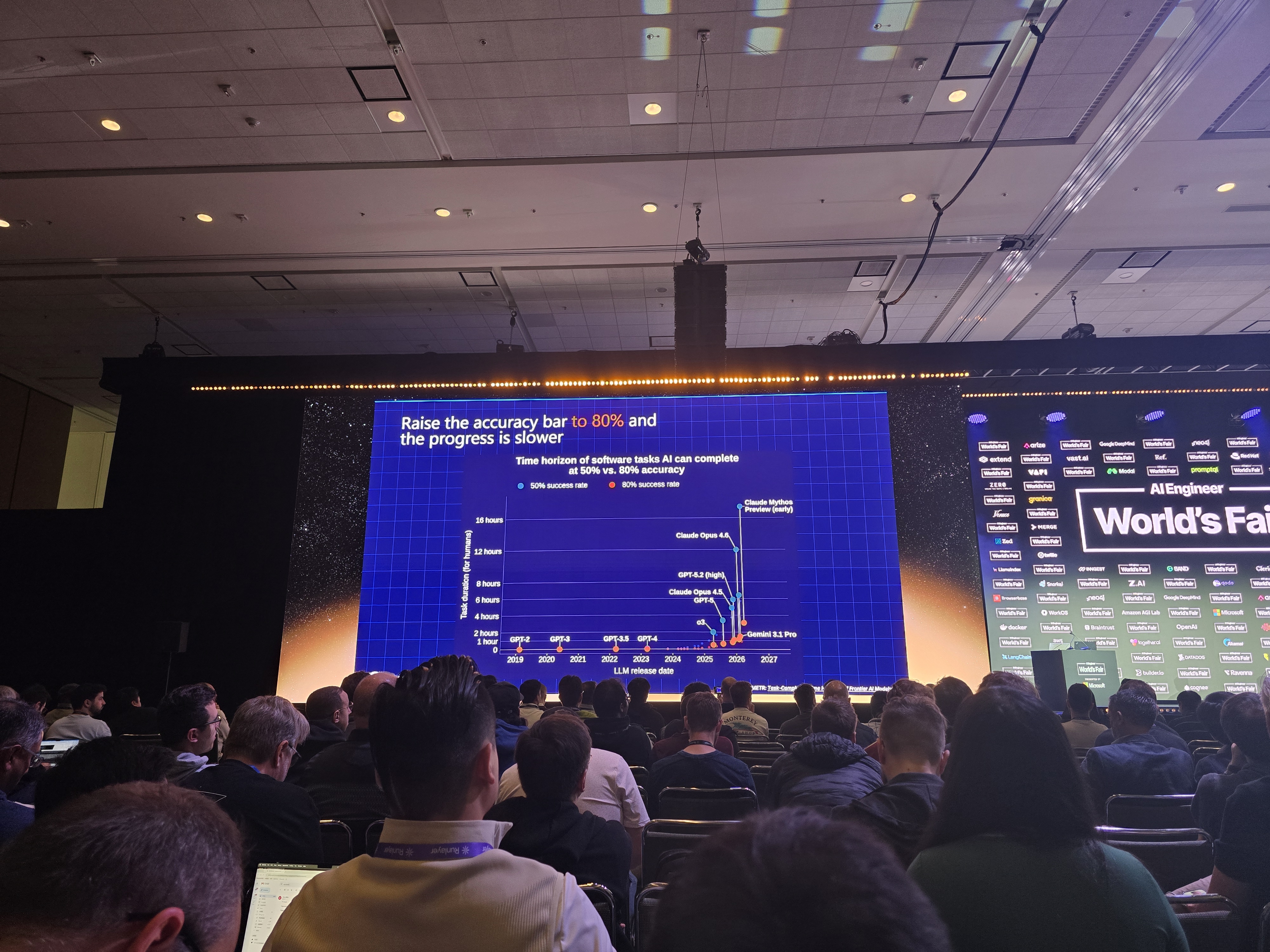
At 50%, models look impressive on long tasks. Raise the bar to 80% and progress slows way down. It doesn't work 100% of the time, and here's the thing, if it's only working 80 or 90% of the time, that basically means it isn't working. Turns out this isn't just a conference talking point either. RAND actually ran the numbers on AI projects broadly:
More than 80 percent of artificial intelligence projects fail, twice the failure rate of IT projects that don't involve AI.
Source: RAND Corporation, "The Root Causes of Failure for Artificial Intelligence Projects and How They Can Succeed", Ryseff, De Bruhl, and Newberry, 2024
The Dyna Robotics talk a few hours later proved that exact math with a napkin-folding robot: 80% success per step sounds fine until you chain 100 steps together, and then your odds of a clean run are basically zero. Sonar told you the theory in the morning, Dyna handed you the receipts in the afternoon, and RAND had already run the numbers before either of them opened their mouths.
* * *
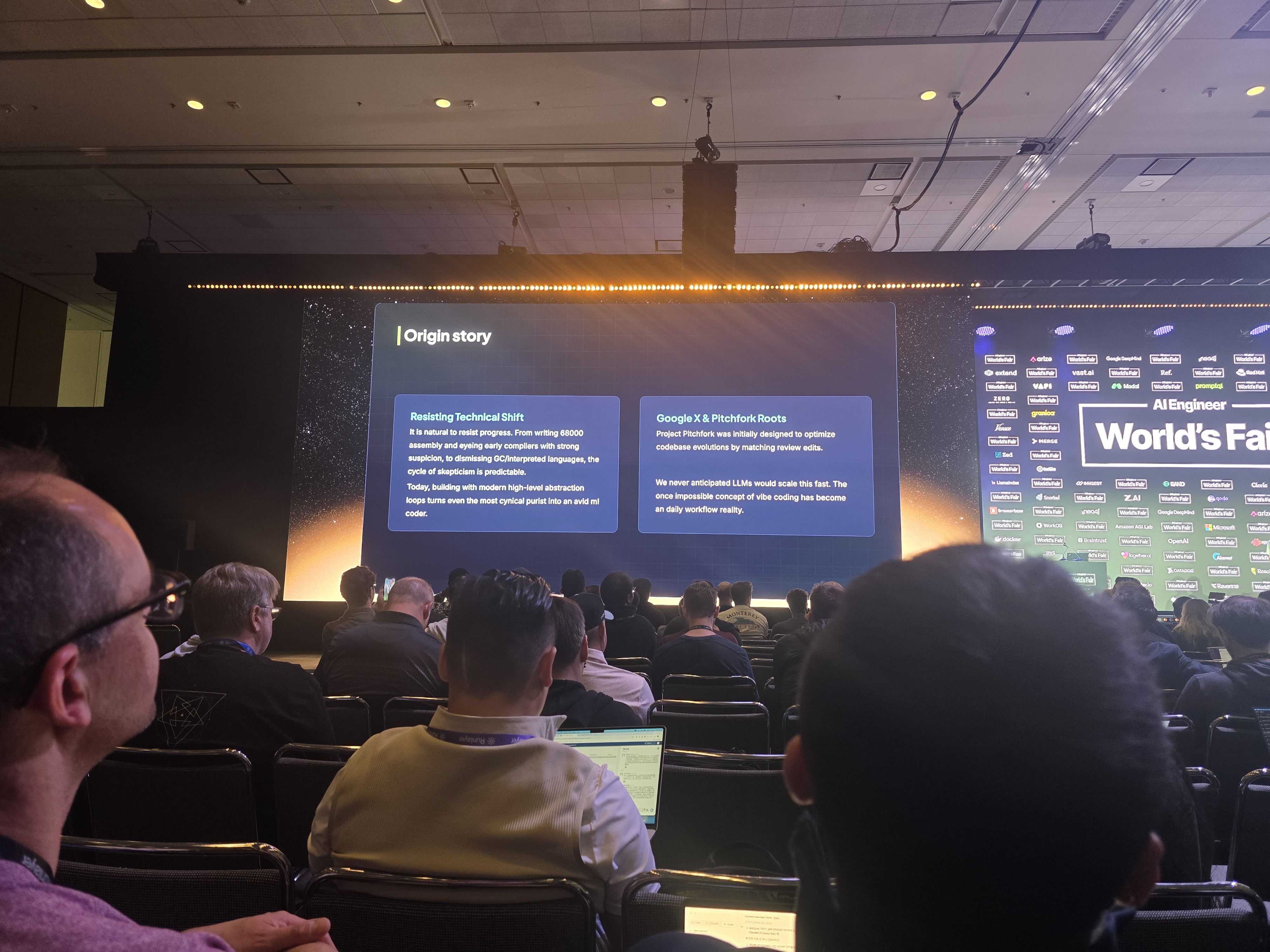
Project Pitchfork, the internal project actually behind Schillings' talk, started at Google X to optimize codebase evolutions by matching review edits. They never anticipated LLMs would scale this fast. Also, Project Pitchfork is the name of an industrial band, and "Timekiller" is probably their most popular song, so that's a connection I can't unlink. Most of the actual talk was pretty boring, the Software Eras framework, the AlphaZero sandbox stuff, fine, whatever, a real Timekiller (ha ha ha ehhh...). What actually got me was the question of whether Python is even the right language for this anymore, or whether there's a language LLMs should be using to talk to each other instead, something closer to that old modem handshake noise than anything a human is supposed to read, like GibberLink, the viral demo where two AI voice agents figure out they're both AI mid-call and drop English for a compressed sound protocol. I'd wondered about that independently before he ever said it out loud.
11:40 AM: Dyna Robotics. With K-Dawg for this one. The rest of the Dyna photos will be in the Conference Errata post, but the short version: napkin-folding robot, genuinely impressive at the one thing it does.

12:15 PM: Lunch at Oasis Grill. Spicy lamb shawarma, decent, not amazing, needed more sauce. With K-Dawg (AI-Dawg skipped, he was at another talk). We took it back inside Moscone and sat and talked shop for a while. K-Dawg headed back home after lunch.
1:30 PM: Unitree's dancing robots. Speaker was XiangMing Sun. I actually caught the practice run before the show started, around 1:06, empty room, just the robot and crew testing it in front of the title slide, which was legitimately fun to watch. I recorded it and sent the video to my wife to show pixie_technologist and yummy_artisan. From what I gathered, the pitch is research robots, something for schools or companies trying to get into the space. Watching for even a minute made it obvious these aren't AI robots thinking for themselves, they're pre-programmed, and there are remote controls in play too. It's a little disappointing once you notice it, but fine, we're not there yet.
Dyna's napkin-folding arms a couple hours earlier were the harder problem: way more room to screw up, way more ways for the thing to confuse itself mid-task, but with enough iterations of training data it actually pulls it off consistently. Restaurants run on strict standards and burn a ton of labor hours on exactly that kind of repetitive precision work. That's real market space a robot like Dyna's can walk right into. Unitree's version is closer to a toy by comparison. This is who Pathak knocks a few minutes later.
After the actual demo wrapped, the robots walked themselves out through the now-packed aisle, flat ground only, don't ask them about stairs, and I watched some guy not paying attention at all walk directly into one, turn around, and dump his coffee all over the floor. Live, in person, not a story I heard secondhand. People are going to break robots because people are stupid.
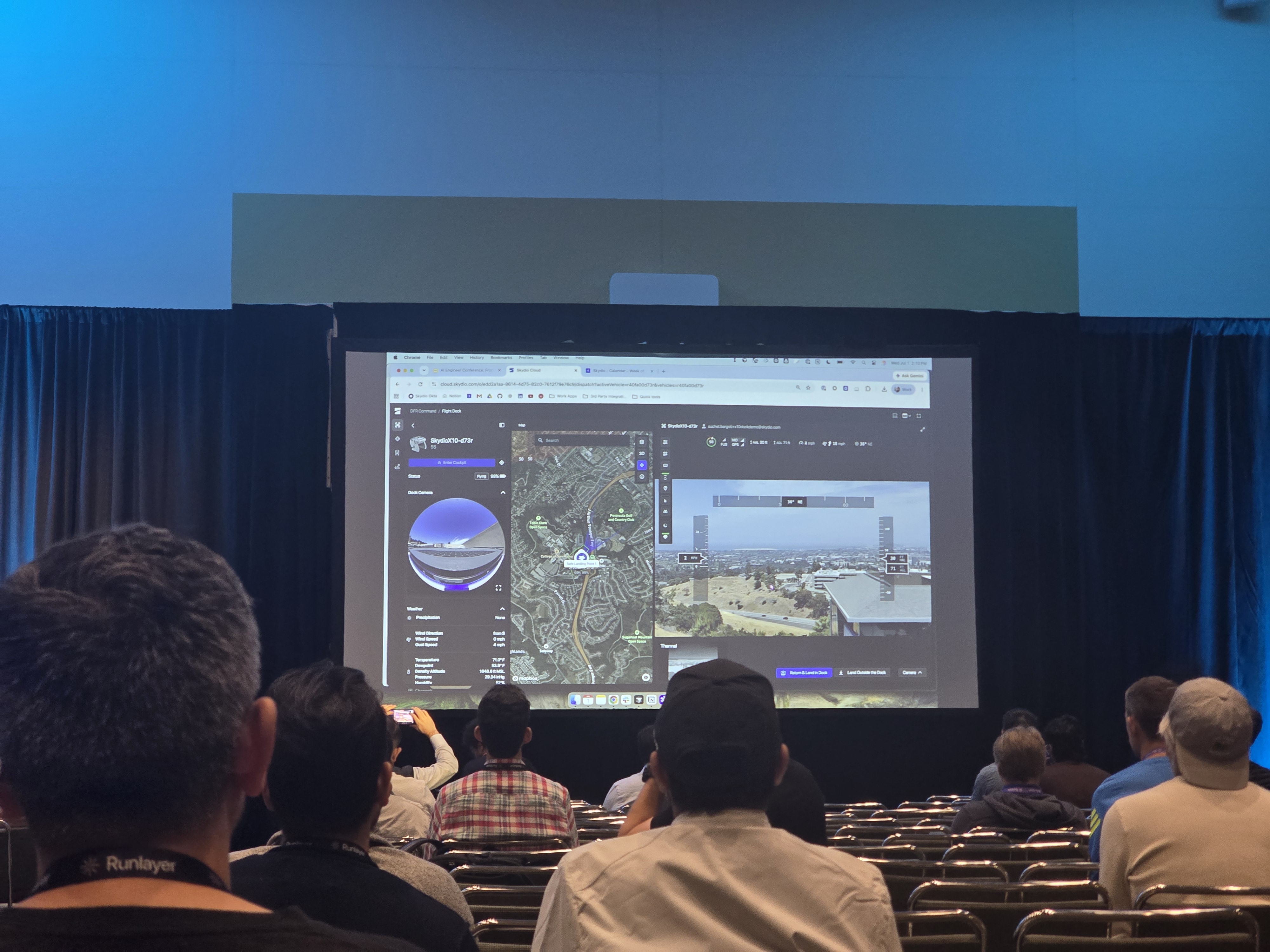
2:10 PM: Skydio drones. The live drone feed from San Mateo AND Denver on screen at once, impressive and unsettling in about equal measure. What actually got under my skin was a clip they showed of a guy caught stealing license plates, caught because the plates were facing up and the drone read them automatically mid-flight. My actual advice to AI-Dawg, leaning over mid-clip: point your stolen plates down. It's great tech, a deeply unsettling application, and I don't think I was the only one in the room feeling both at once. Skydio's also hiring around 200 roles right now, which is the kind of number that makes you start guessing there's serious government funding behind the scenes. AI-Dawg and I both landed on that guess independently.
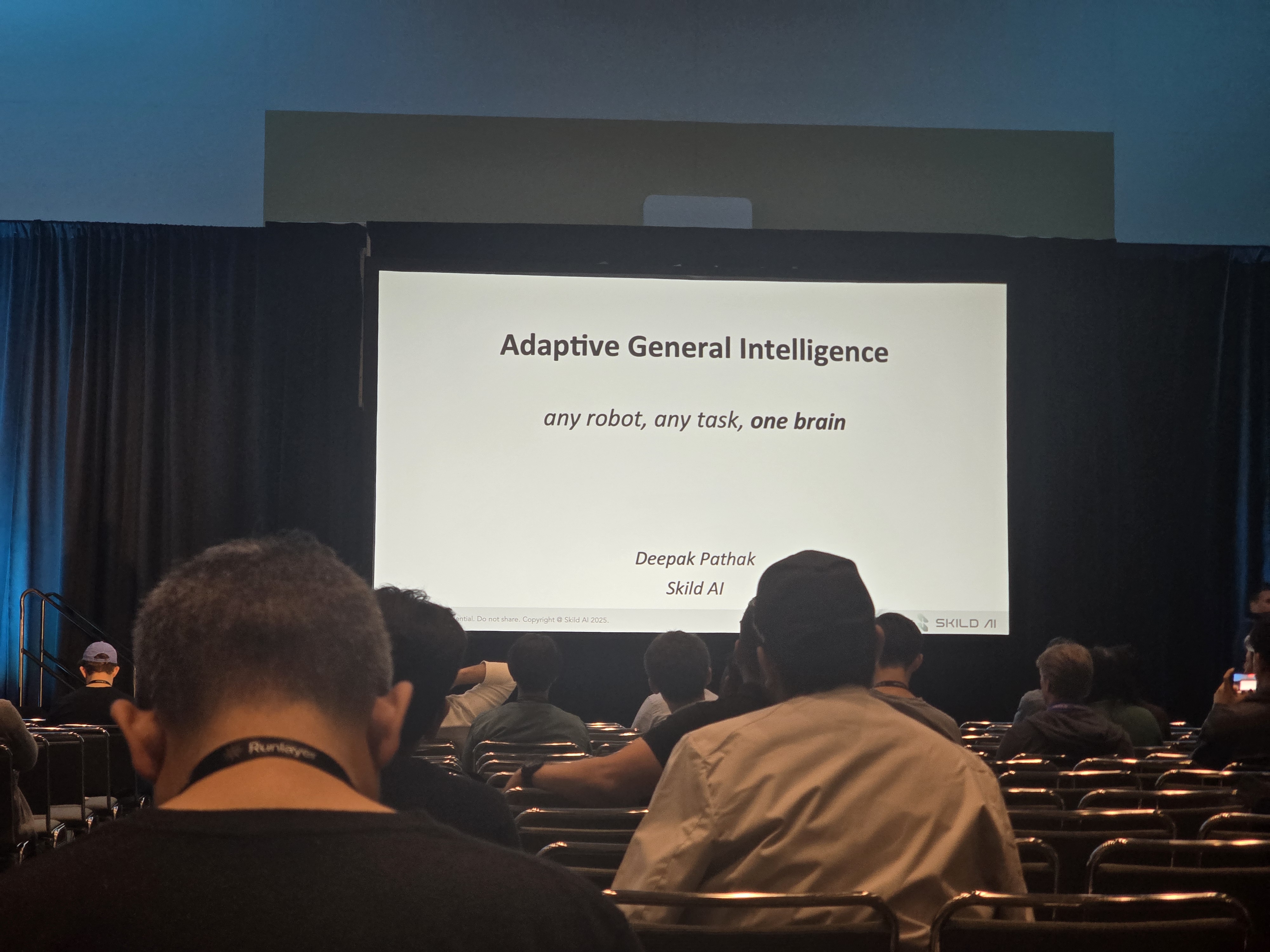
~2:31 PM, running very late: Frontier Robotics Research (Pathak). Sessions in the robotics track got shuffled (Pathak was stuck in traffic), so late that this ended up running after the drone session in a different room, not before it, despite the schedule listing his talk earlier. This dude's a slacker. Pair the lateness with his slides all being marked "Confidential. Do Not Share." at a public conference: young professor energy, not having his shit together, but the technical content held up fine. Then the line landed: "Can they go up and down stairs? No. Then what's the point?" aimed straight at what Unitree just showed, and it wasn't some hypothetical jab. The Dyna robots from earlier that same day had literally just been carried up and down stairs between sessions, by hand, because they couldn't do it themselves. He wasn't making a rhetorical point, he was pointing at something that had happened in the same building a few hours earlier. His talk's whole frame was right there in the title, "any robot, any task, one brain," and it's basically the antidote to everything I'd watched that day. Dyna's napkin-folder, Unitree's dancers, one brain, one job, nothing transferable to the next robot or the next task.
~2:50 PM: Back to the expo floor. One more pass, general browsing.
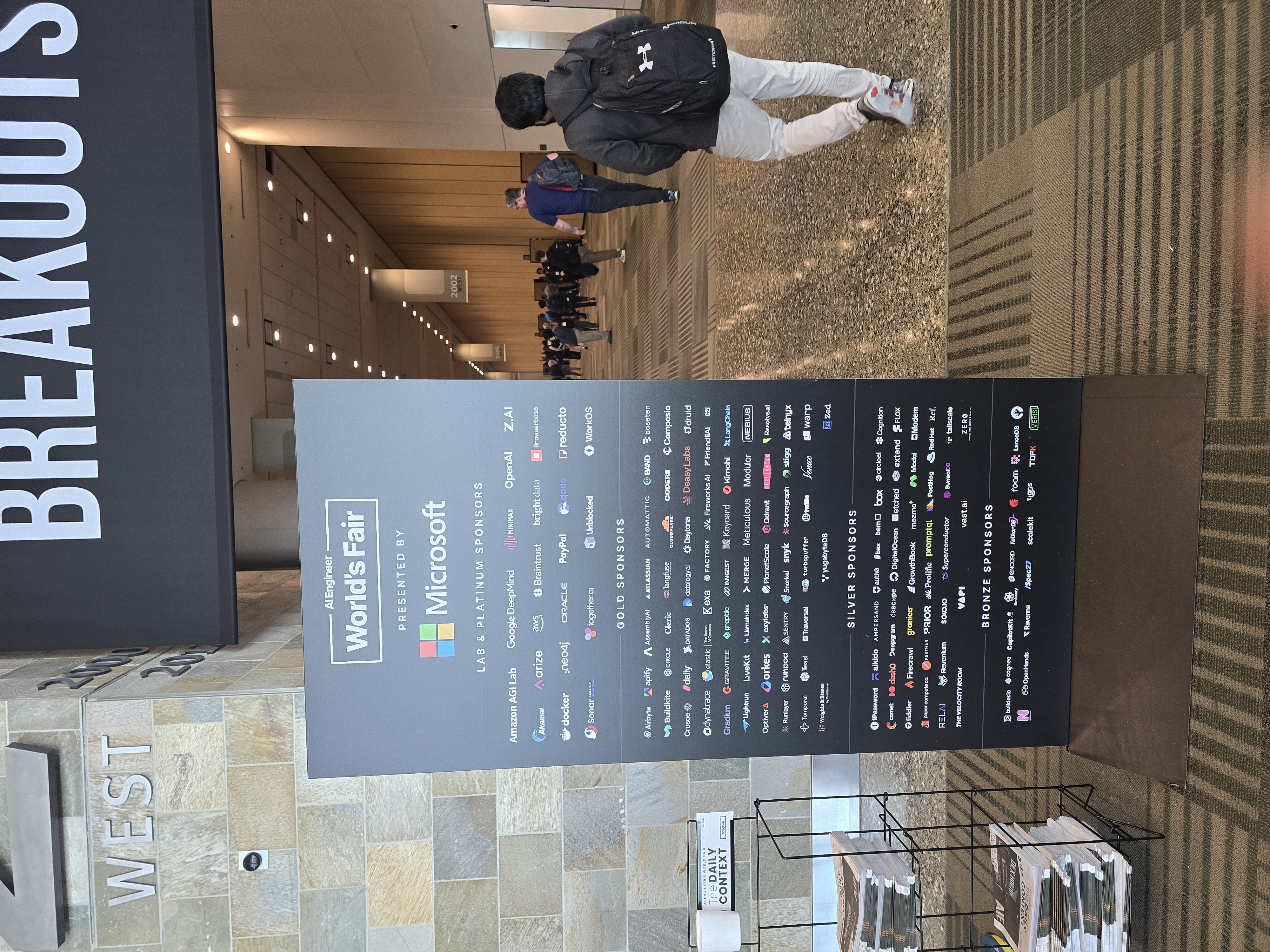
~3:06 PM: The sponsor board. Microsoft presenting, full tier list laid out. This is the board I mentioned up top, the one Anthropic isn't on. Confirmed in person, camera in hand: not a tier, not a footnote, nothing.
3:20 PM: The Zoox walkout. I've got a real interest in autonomous vehicles, and figured a talk called "From Self-Driving Monorepo to Self-Driving Cars" would cover something about the actual technology. Amit Navindgi, a Senior Staff Software Engineer at Zoox, opened with something close to: "This isn't going to be about self-driving cars, it's about how we set up our agents, our workflows..." If the title says self-driving cars, talk about self-driving cars. Instead it was all about their internal dev workflow. Zero interest. AI-Dawg and I walked out together.
~5:00 PM: Called it for the day. Caught up on email and Slack.
5:30 PM: World Cup at the hotel bar. The plan was dinner first, but USA-Bosnia & Herzegovina was on, so AI-Dawg and I camped out at the hotel bar instead and watched the US win 2-0. The red card was BS. But FIFA is also corrupt. Right outcome, wrong path.
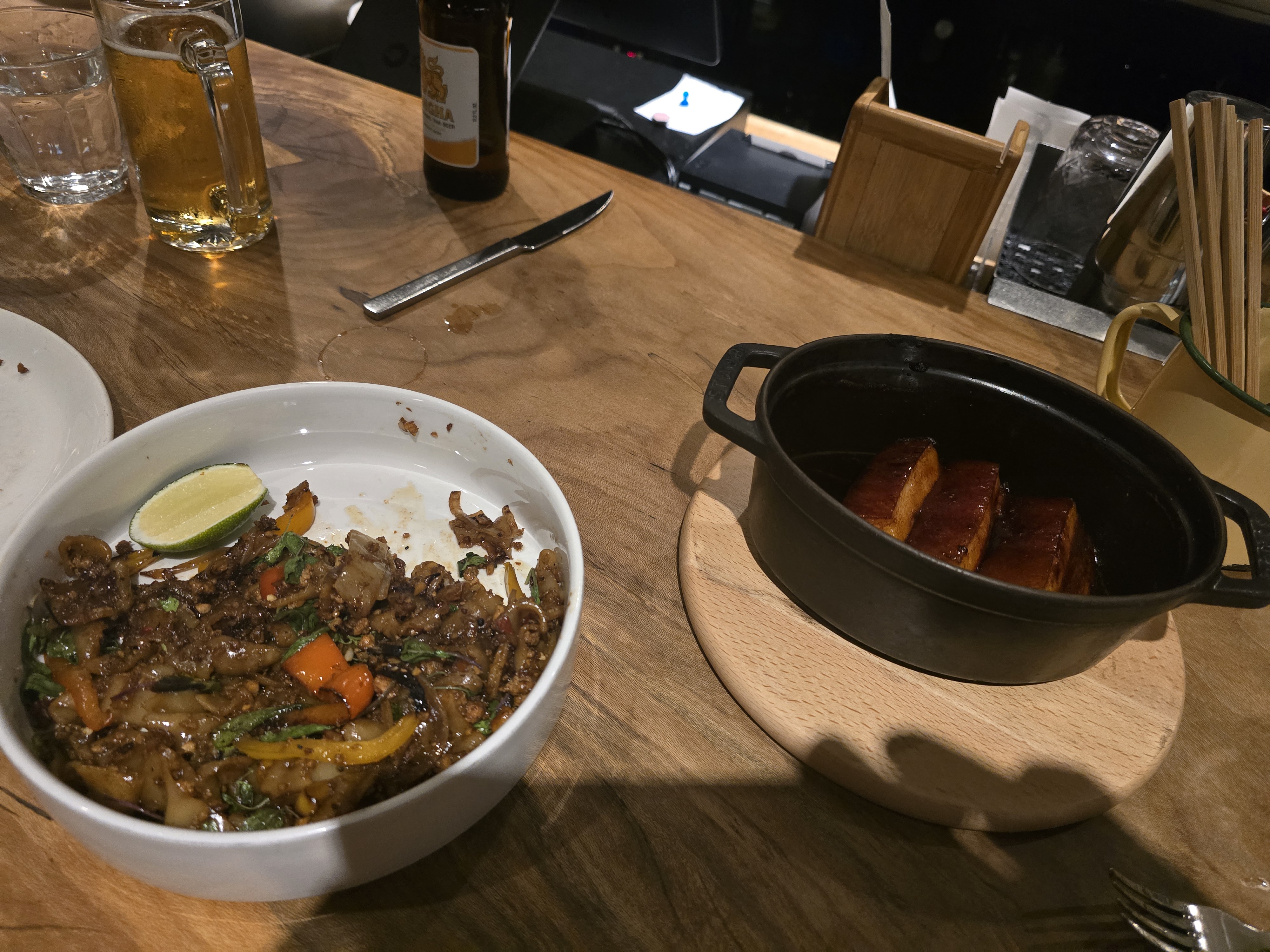
~7:36 PM: Dinner at Kin Khao. Michelin 1-star Thai. Caramelized pork belly in a cast iron pot, Pad Kee Mao (drunken noodles, tofu, bell peppers, basil, lime), hot wings (not pictured, I forgot). It was about $60 with a beer, and worth every cent.
Day 4's main stage ran four sessions back to back:
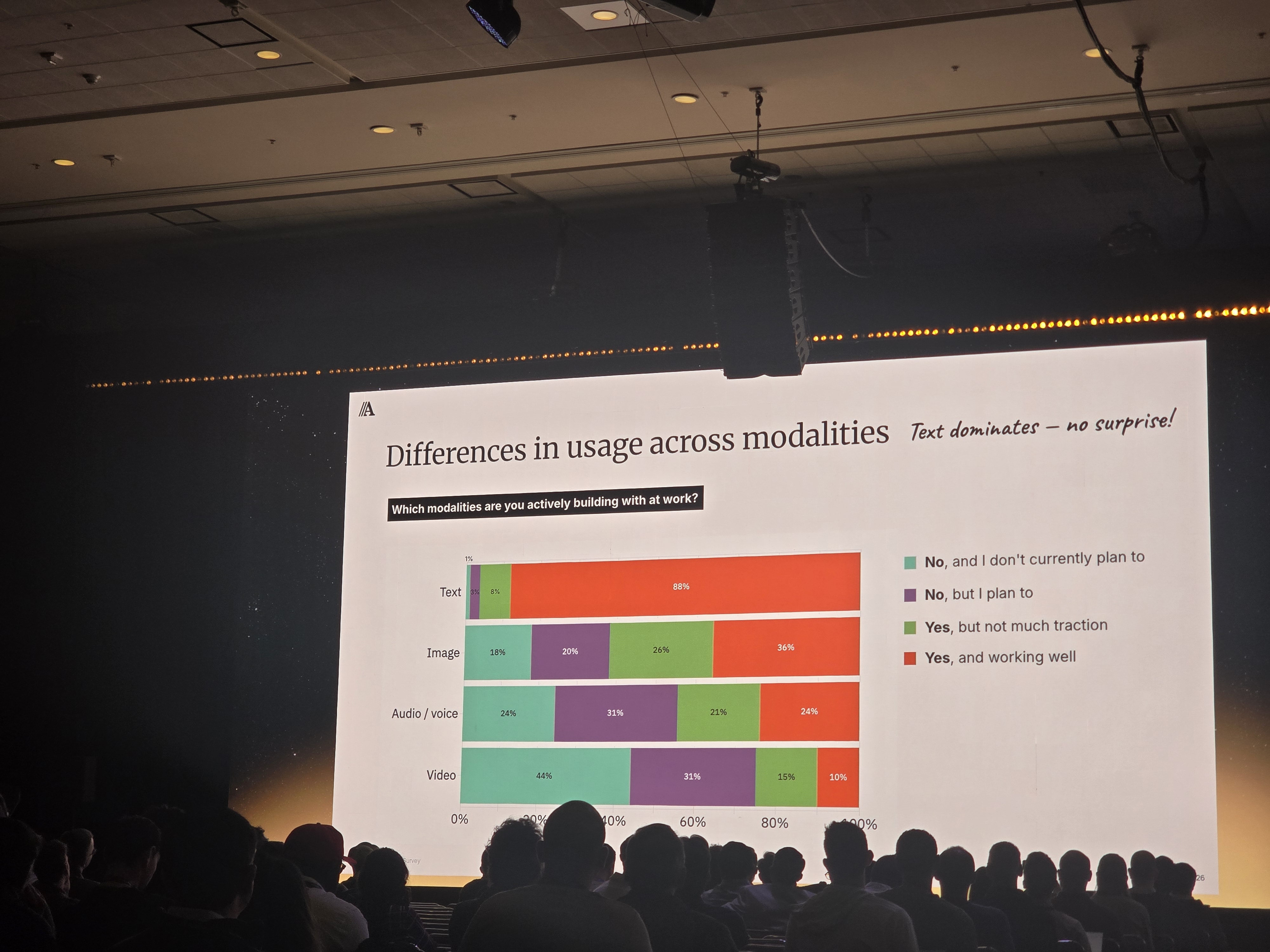
9:00 AM: "The 2026 State of AI Engineering" (Barr Yaron, Amplify Partners). 1,048 engineers surveyed. One number to carry out of the room: when engineers pick a model, accuracy matters to 67% of them and reliability/uptime to 20%. The rest of the numbers get a full post.
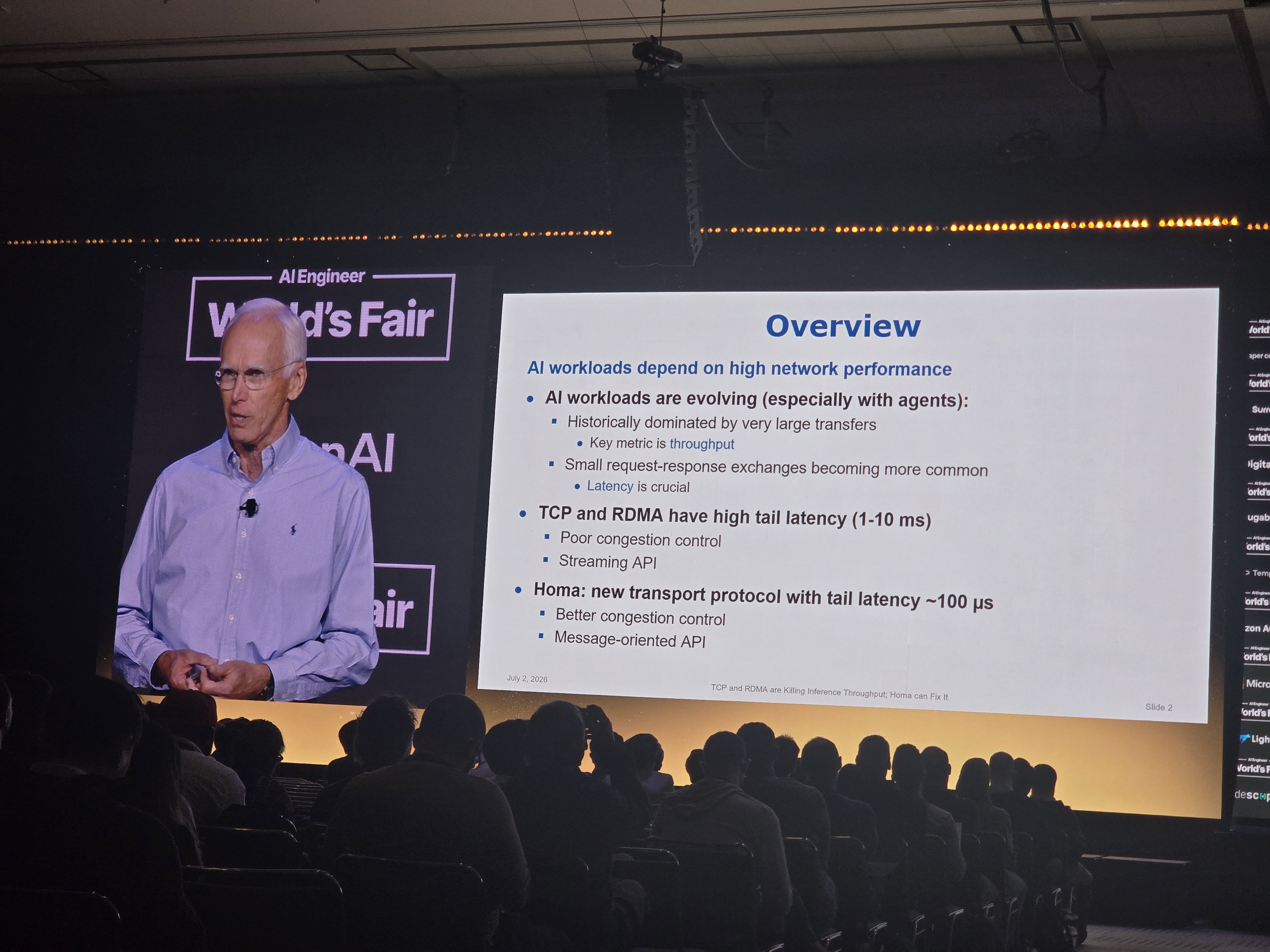
9:20 AM: "TCP and RDMA are Killing Inference Throughput; Homa can Fix It" (John Ousterhout, Stanford). The creator of Tcl/Tk and Raft, on stage with a kernel module that cuts P99 tail latency for short messages by 13x. Deep dive coming.
9:40 AM: "The Unreasonable Effectiveness of Separating the Task from the Model" (DSPy). It was an ad. Covered honestly in the Conference Errata post. It's UNREASONABLE to ask me to sit through this.
10:00 AM: "How Anthropic Builds: Lessons from Labs" (Mike Krieger interviewed by swyx). Claude Tag, the 65% internal code claim, and swyx suggesting Instagram be rewritten from Python to PHP.
Survey kicked off the day, and it was the only one of the four built on actual data instead of hand-waving. The reliability-ranked-near-the-bottom take gets the full treatment in its own post, so I won't repeat it here, but it set the tone for the morning.
Ousterhout/Homa was the one that stuck with me. When someone with that resume gets on stage to talk about protocols, you listen. He asked the room who was already hitting the problem he was describing, and only a handful of hands went up, which visibly surprised even him. AI-Dawg and I both walked out of that one thinking Homa is going to be a thing.
DSPy: see above.
Krieger x swyx was sleek, polished, a little ad-like too, and it landed right after the whole backdrop-logo thing from Day 3, so the "we're not officially sponsoring but we're everywhere that matters" feeling was already sitting in my head walking in. Claude Tag's 65%-of-internal-code claim left me skeptical it translates outside Anthropic. Works great for their own use case, doesn't obviously map to most customer bases. The swyx "Instagram rewritten from Python to PHP" roast was a genuinely good bit, playing off the old Facebook acquisition. Krieger's actual comeback: "well, be unreasonable, ask Fable5 to do it," a direct callback to the "Being Unreasonable" quadrant of Shihipar's talk the day before. Same marketing beat, different session, different speaker, and it's still landing two days later. Krieger also talked about Anthropic's recurring Wednesday all-hands, the standing meeting where they go over the current state of AI, and the line he dropped about it, "We have Wednesday company meetings on the state of AI. And it's only Wednesday!", is a quote I'm going to keep using about the pace of this stuff.
Day 4, 10:20 AM: Bailed on Neo4j. Skipped it and hit the expo floor instead for one more pass. Everything from here down is Day 4 wind-down.
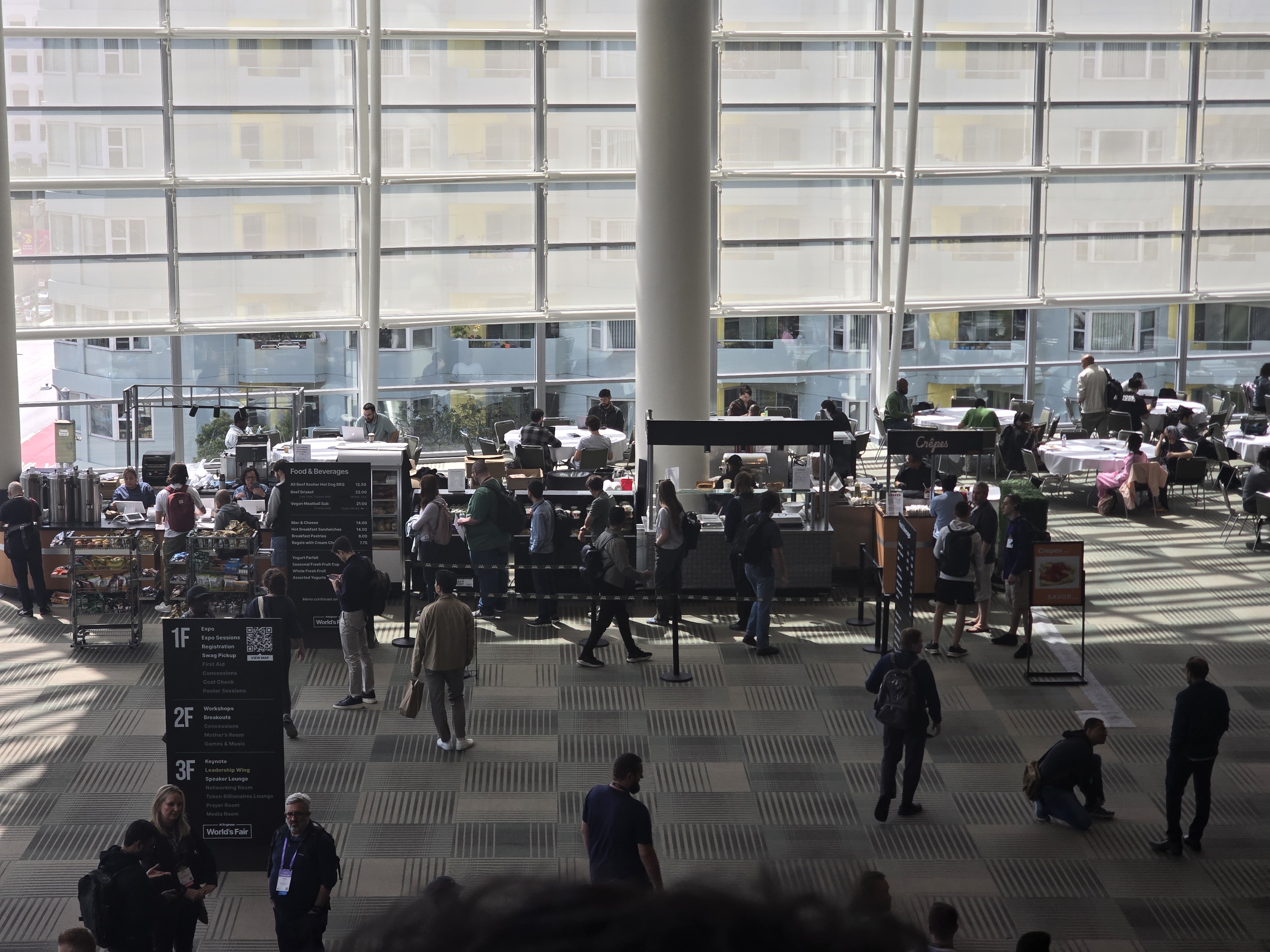
~10:30 AM: Food court break. Moscone lobby had a whole crepes station going, full food and beverage spread. Didn't actually eat any of it, just grabbed a shot of the madness.
Expo floor, final pass. Scored a Datadog t-shirt (XX-L, good for sleeping in, according to the booth girl) and some Microsoft stickers, had a couple conversations with companies about product ideas, nothing to commit to right now, but worth revisiting.
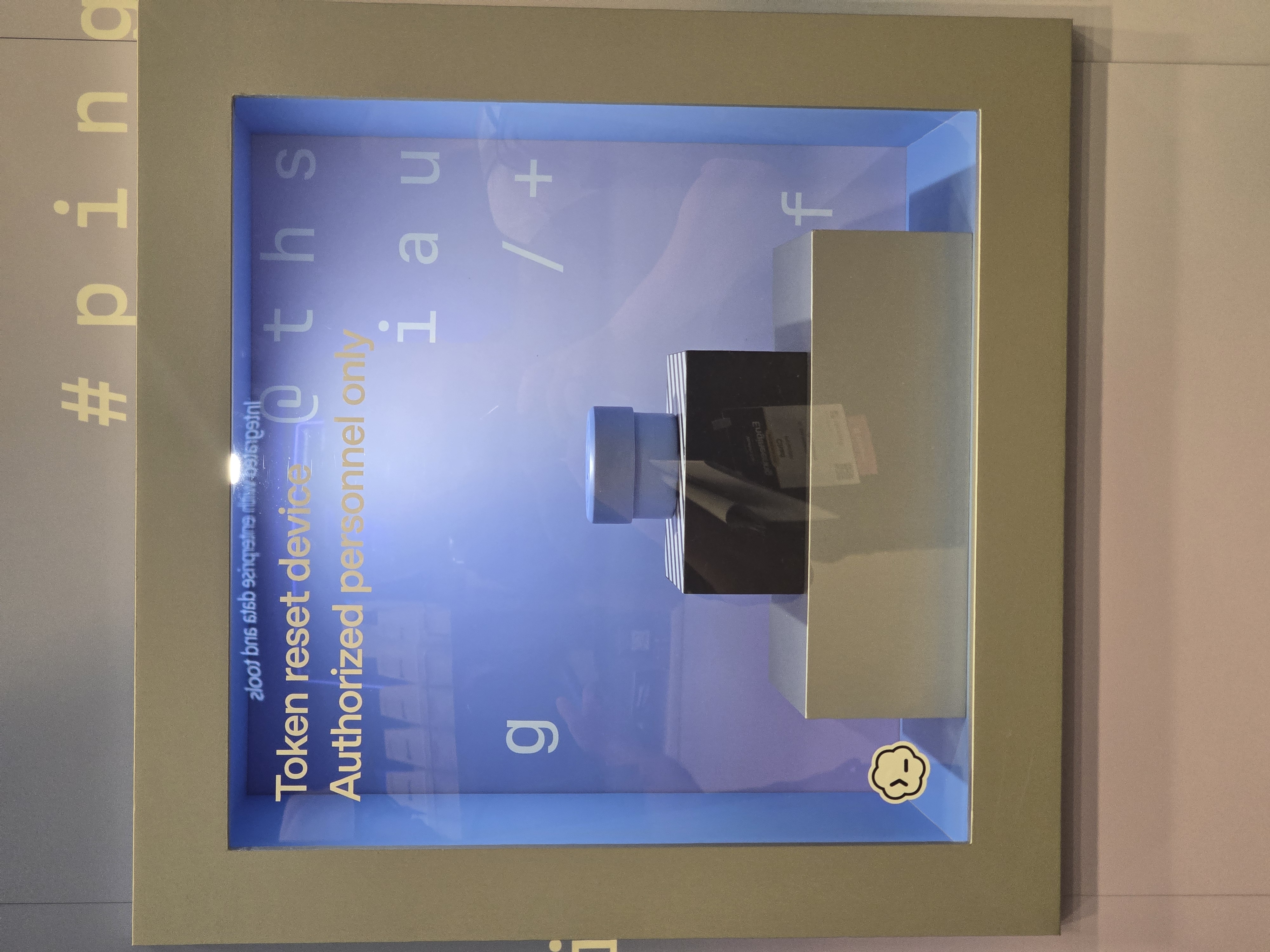
~10:53 AM: The Clerk booth. A "Token reset device, Authorized personnel only" prop sitting in a lit glass display case, auth code paths etched right into the wall behind it.
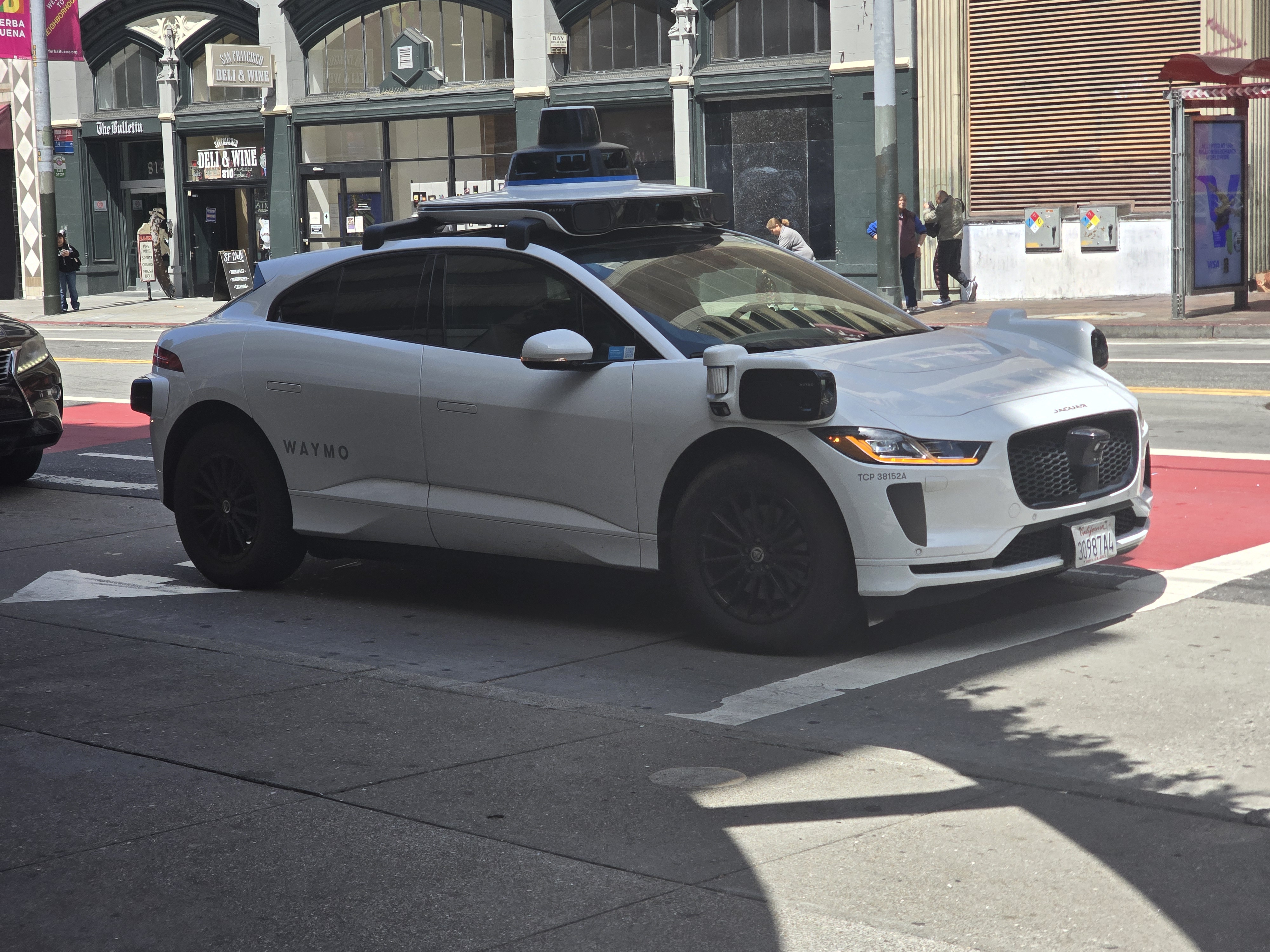
~11:28 AM: Spotting the Waymo. A Jaguar I-PACE, full sensor stack, parked right outside Moscone. Fitting end to a week of autonomous everything. By the way, these things were all over the place every single day, I just happened to get the picture on this one.
~11:30 AM: Lunch at Cable 55. With AI-Dawg, his flight got delayed two hours so we just kept talking, ended up sitting there until about 2:30 PM.
~2:30 PM: Solo in the hotel room. Watching the SF skyline, flight home tomorrow at noon.
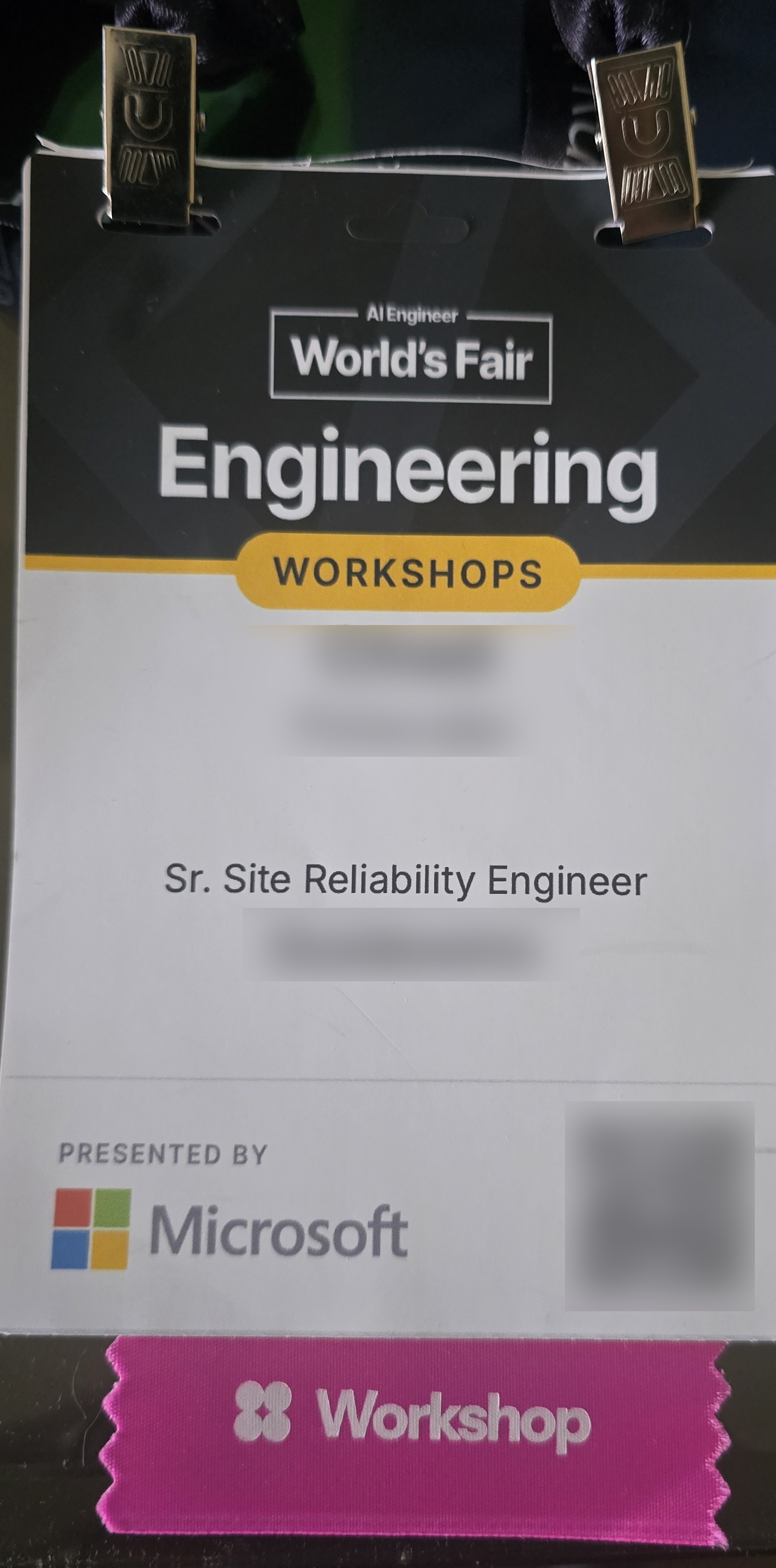
~3:19 PM: Badge photo.
Evening: Dinner back at Cable 55. Watched soccer, burger was huge. Good close on the flight-home feeling. Nobody at this conference, not even the experts on stage, has a real map of where any of this goes. A company is more than its codebase, culture, institutional knowledge, judgment, all the stuff the "AI replaces engineering" framing conveniently ignores.

A lot of booths on the expo floor had their own rubber duck as swag, dozens of different ones by the end of the week. I only grabbed three, and they went straight home to the kids. Somewhere in the middle of a week built entirely on trusting things that talk back to you, that felt exactly right. The oldest debugging trick in the industry is a duck that says nothing back at all, and it's still the fastest way to catch what you missed.

Places I Checked Out (And Maybe You Should, Too)
Quick vendor roundup across all four days, expo floor chats and booth visits that didn't fit the narrative anywhere else. Nothing deep, just a directory:
- Day 1: robots from robot.com, a Weights & Biases robot, brief chats with Resolv.ai and Keycard
- Day 2: chatted with booths for Postman, Band, Temporal
- Day 4: scored a Datadog t-shirt and some Microsoft stickers, chatted with Qodo and Browserbase, a couple other product-idea conversations with companies not worth naming yet
No strong opinions on any of these individually, just flagging them in case a reader wants to go look themselves.